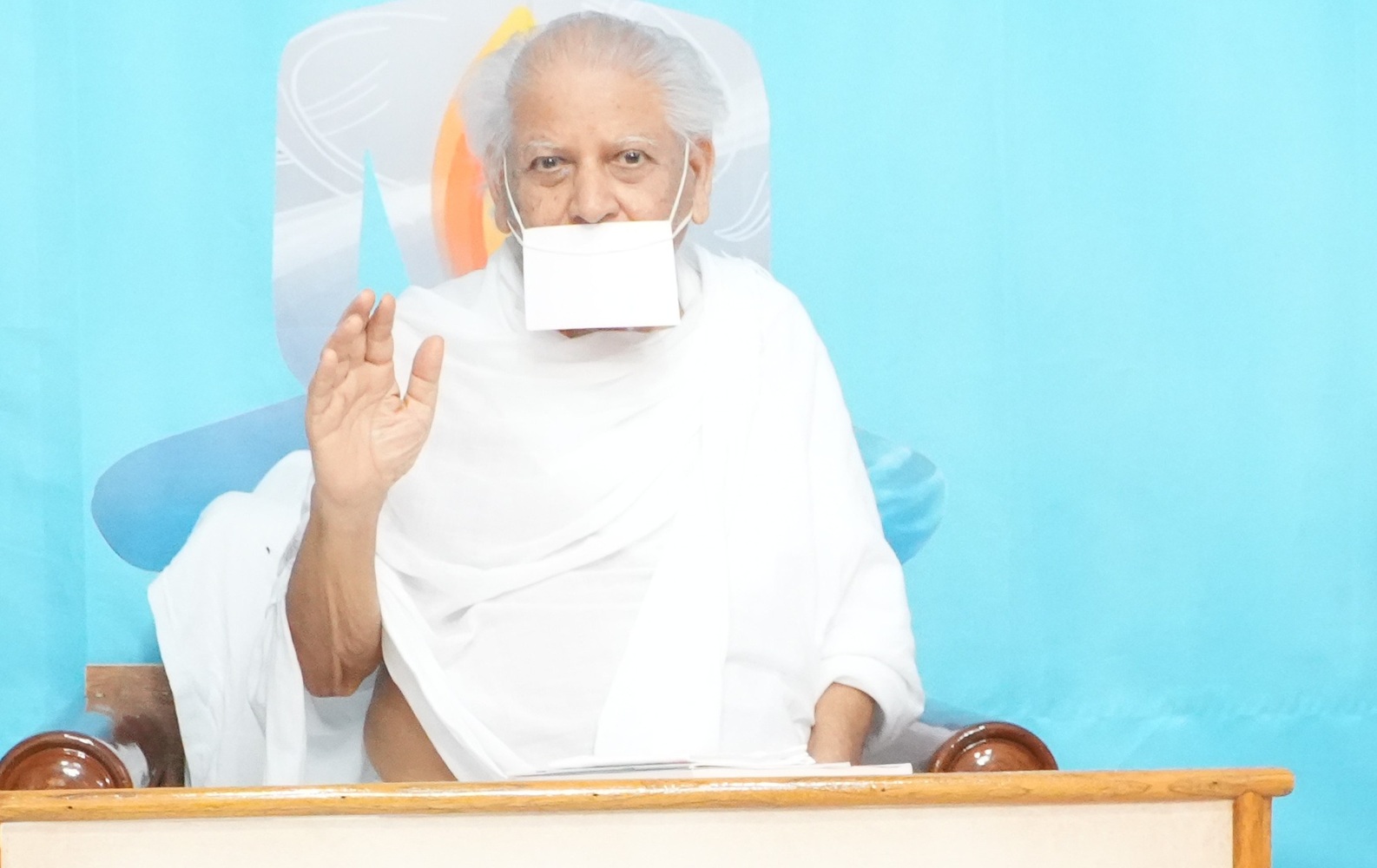
In his discourse regarding the Samadhi Tantra (the science of meditative absorption), Acharya Samrat Dr. Shri Shivmuni Ji M.Sa. stated that the true nature of the Supreme Soul (Paramatma) is the Soul (Atma) itself. When the intellect and the senses become entangled with the mind, the living being forgets its true self. When the living being invests its energy in the physical body, it wanders through the four realms of existence (gatis) and the 8.4 million life forms (yonis).
Acharya Bhagavan further explained that when the senses are restrained even for a moment and the consciousness (chitta) becomes tranquil, the living being attains stability. One should focus the mind on a virtuous and pure object of contemplation (aalamban) to achieve mental stability. Regarding a virtuous object of contemplation, one should first observe and become aware of the incoming and outgoing breath. Subsequently, contemplating the qualities of the Soul calms the consciousness. A seeker who attains the state of pure Self-realization experiences that “I am the Supreme Soul, and the Supreme Soul is who I am”; there is no difference between the two.
While interpreting the first sutra of the Acharanga Sutra, he stated that “Soham” is the opening sutra of the Acharanga. The living being has journeyed through the realms of celestial beings, humans, animals/birds (tiryanch), and hellish beings; and this very being—”Soham”—is “I myself.” The syllable “So” signifies the Soul; the very Soul that exists within the Siddhas (Liberated Souls), Arihants (Enlightened Ones), and Acharyas (Spiritual Masters) is the Soul that I am. The Soul is singular, though its external guise keeps changing. Jain philosophy emphasizes the Soul, asserting that a seeker who has truly known the living being (Jiva) has, in essence, known everything. A seeker of the Self (Atmarthi) has no need for external rituals, mystical practices (tantra), or ceremonial worship; such rituals and actions may exist only from the perspective of worldly conduct (vyavahar drishti). For instance, the tenets of Vyavahar Samyaktva (Right Faith in practice) state: the Arihant is my Deity; the virtuous ascetics (Susadhu) who follow the path of the Arihant Lord are my spiritual guides (Gurus); and the Dharma expounded by the Kevali (Omniscient One) is my Dharma. Experiencing the soul, knowing it, and becoming steadfast in it—this constitutes Samyaktva (Right Faith). The soul itself is the Guru; the soul is the supreme authority.
He further stated that a seeker dedicated to the soul (Atmarthi) must keep the Jiva (living soul) at the center of their focus. To make the Jiva the focal point, one should practice Bhed-Vigyan—the discernment that distinguishes between the insentient (Jada) and the sentient (Jiva). Just as a student, while performing daily routines, constantly aims to achieve good grades and works towards that goal, or a physician focuses on the successful treatment of a patient, similarly, a seeker of the soul should keep their focus centered on the soul while performing all their activities.
Pramukh Mantri Shri Shirish Muni Ji M.S. spoke about Ashrav Anupreksha (contemplation on the influx of karma), stating that Samyak Darshan (Right Faith) is essential to strengthen the foundation of the edifice of Moksha (liberation). There are seven Tattvas (fundamental principles): Jiva (living soul), Ajiva (non-living matter), Ashrav (influx of karma), Bandha (bondage of karma), Samvar (stoppage of influx), Nirjara (shedding of karma), and Moksha (liberation). If these seven are condensed, the two primary principles are Jiva and Ajiva. One must cultivate the conviction: “I am the Jiva; everything other than the Jiva is Ajiva.” Ashrav refers to the channels through which karma enters the soul. When Ashrav is accompanied by passions (Kashaya) and feelings of attachment (Raga) and aversion (Dvesha), it leads to the bondage of karma.
‘Pravachan Prabhakar’ Shri Shamit Muni Ji M.S. presented the devotional song (bhajan) titled “Antar ke Aatma ki Shakti Bhari” (The inner soul possesses immense power).
Shri Shantilal and Smt. Suman Ostwal from Bhilwara took the vow (Pratyakhyan) for a 13-day fast via the online platform. Additionally, other Tapasvis (ascetics/practitioners of penance) took vows—both online and in person—to observe various austerities such as fasting, Ekasan (eating a single meal a day), and Ayambil (eating a specific type of simple, unspiced food once a day).